Gomoku Strategy Guide: How to Get Five in a Row
EspañolGomoku — also known as Five in a Row — looks like a very simple game: place stones, line up five, win. But beneath that simplicity lies a surprisingly deep strategic battle built around pattern recognition and planning ahead.
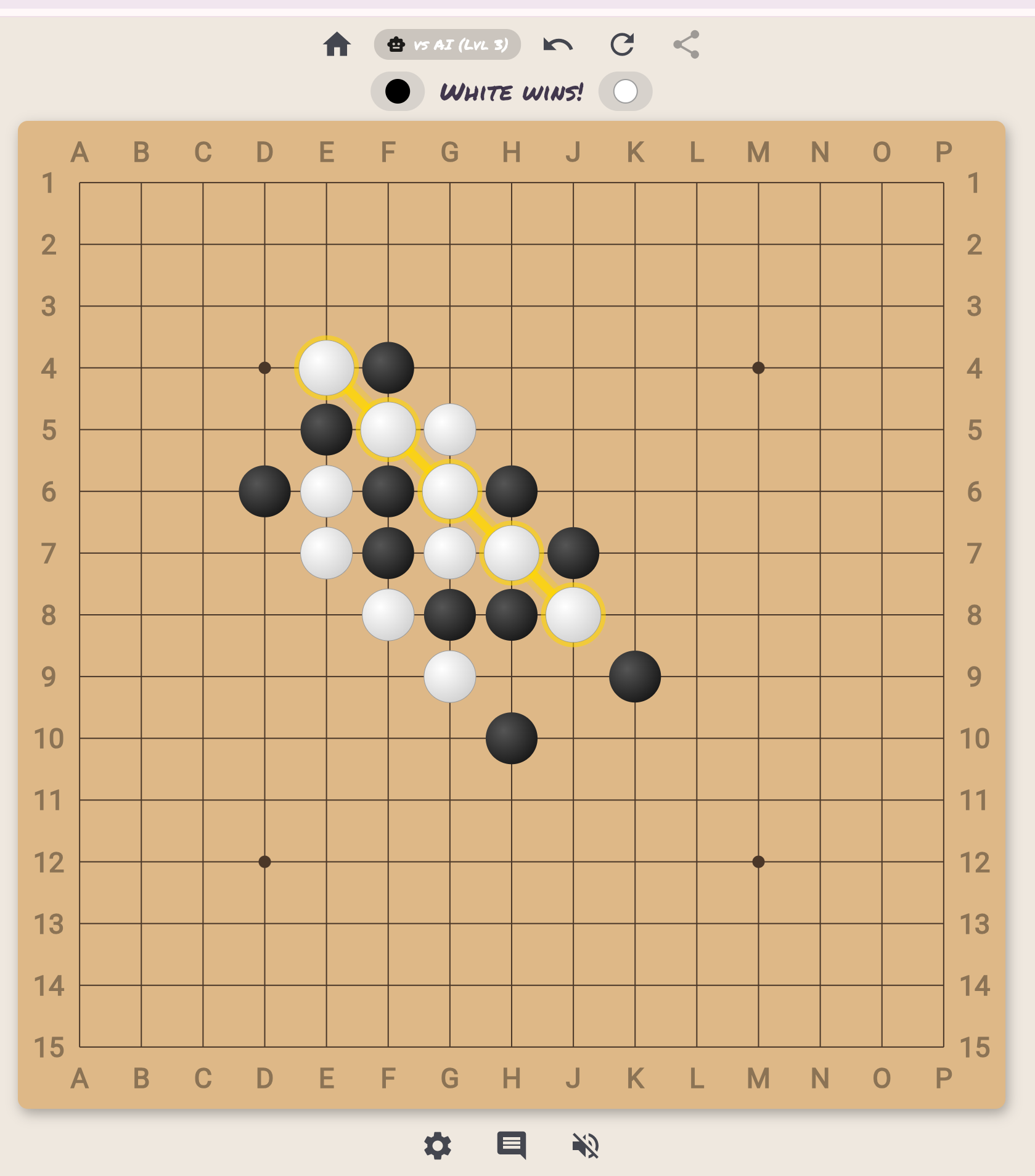
Strong players don’t just react to their opponent’s moves — they create threats and traps several moves in advance.
The Basic Idea
Two players alternate placing black and white stones on a 15×15 grid. The first player to get five stones in an unbroken row — horizontally, vertically, or diagonally — wins.
There are no captures and no territory scoring. Victory comes purely from building the right patterns and preventing your opponent from doing the same.
Winning Strategies
1. Control the Center
The center of the board gives your stones the most room to grow in every direction.
Opening near the center maximizes your options and limits your opponent’s ability to restrict your lines. Stones played near the edge or corners can only extend in a few directions, while center stones can build threats in all four.
2. Build Open Threes
An open three is three stones in a row with empty spaces on both ends.
This is one of the most important attacking patterns in gomoku because your opponent can only block one side at a time. If they don’t respond immediately, you can extend it into an open four, which usually guarantees a win on the next move.
Key idea: Aim for open threes, not closed ones.
Three in a row blocked on one side is much easier to defend.
3. Create Double Threats (Fork Attacks)
The strongest moves in gomoku create two threats at the same time.
For example, placing one stone might create:
- two open threes, or
- an open three and a four
Your opponent can only block one of them. The other threat becomes your winning move.
Learning how to create these forks is one of the biggest steps toward becoming a strong Gomoku player.
4. Block Early
When your opponent forms an open three, you should usually block it immediately.
An open three is a warning sign. If it becomes an open four, the game is often already lost.
When choosing which side to block, block toward the center whenever possible. Stones near the center can extend in more directions, so blocking toward the edge limits your opponent’s future options more effectively.
Experienced players constantly scan the board for developing threats and stop them before they become unstoppable.
A useful rule:
- Two stones in a row deserve attention.
- Three stones in a row demand action.
5. Think Two Moves Ahead
Before placing a stone, ask yourself:
“If I play here and my opponent blocks it, what is my next move?”
Strong gomoku play is built around forcing sequences — moves that force the opponent to respond in a specific way, allowing you to build the next threat.
Thinking one move at a time rarely works against a prepared opponent.
Common Patterns to Know
Beyond the open threes and forks described above, watch for these patterns:
- Broken three: three stones with a gap in between (e.g.,
X_XXorXX_X). These are harder to spot but can be just as dangerous — they can become open fours with a single move filling the gap. - Closed four: four stones in a row blocked on one end. Your opponent must block the open end or lose immediately. Use these to force moves and set up your next threat.
Recognizing these patterns quickly — both your own and your opponent’s — is one of the fastest ways to improve.
Why Gomoku Is Harder Than It Looks
Because stones never move once placed, every move permanently shapes the board. A single mistake can create a weakness that your opponent can exploit several turns later.
It’s worth knowing that on a standard 15×15 board, the first player (Black) has a proven winning advantage with perfect play. That’s why many competitive rule sets add restrictions on Black’s opening moves to keep the game balanced. Even in casual play, going first is a meaningful edge — so use it wisely.
That is what makes gomoku so addictive: simple rules, but endless tactical possibilities.
Ready to Play?
Strategy becomes much clearer when you see it on the board.
Play Gomoku online and try creating open threes and double threats yourself. After a few games you’ll start spotting patterns much faster — and winning more often.