Picaria Rules & Strategy: How to Play and Win
EspañolPicaria is a traditional strategy game from the Pueblo peoples of the American Southwest. Played for centuries in what is now New Mexico, the game was drawn in the dirt and played with stones or sticks. It looks simple — place three pieces, slide them around, get three in a row. But the board’s unusual geometry and the restriction on the center position create a game with far more depth than you’d expect from just six pieces.
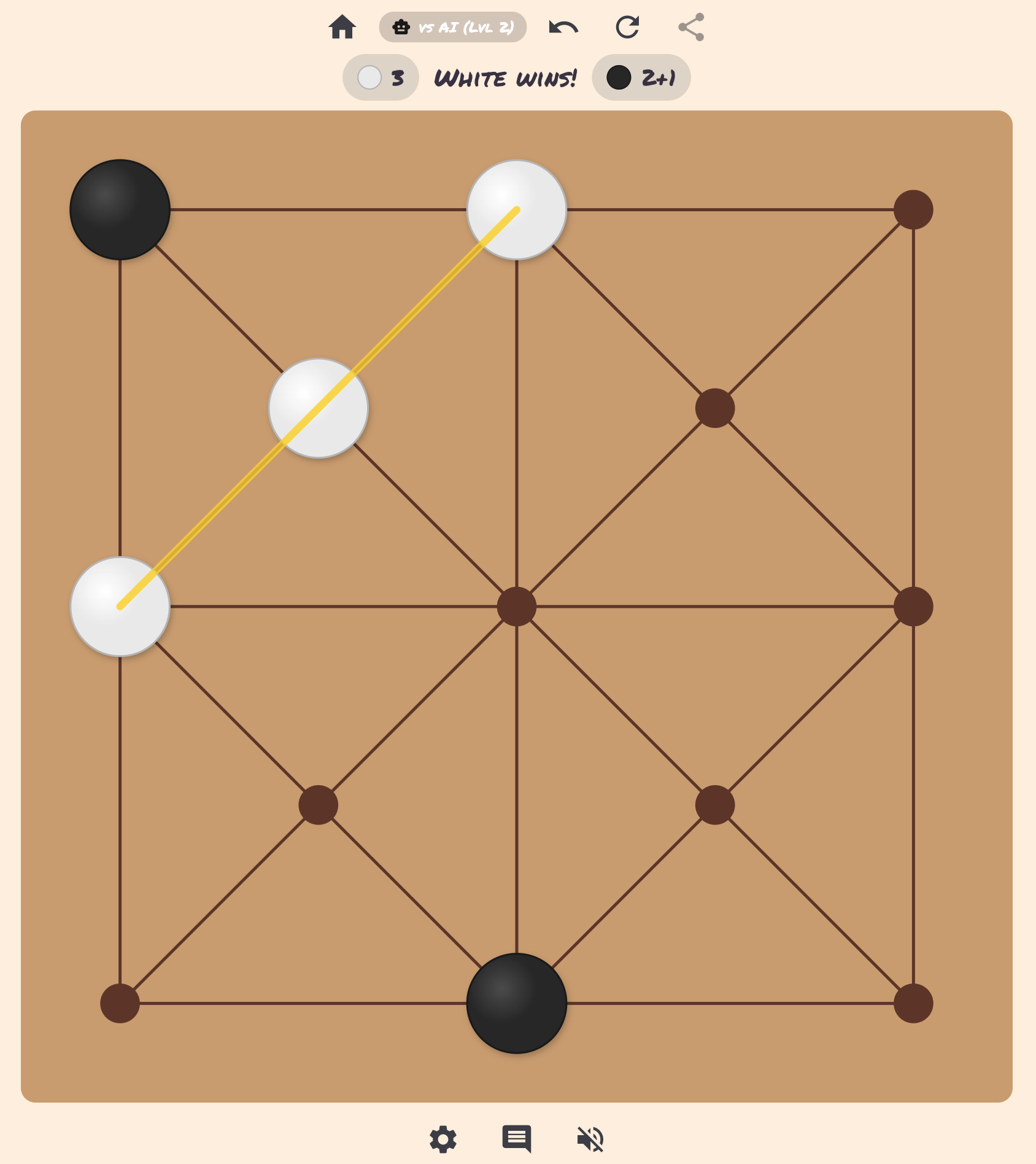
The Board
Picaria is played on a board with 13 positions connected by lines. Picture a 3 by 3 grid — the nine intersections of a tic-tac-toe board — with four extra points at the centers of the four smaller squares formed by the grid.
These sub-square centers are connected diagonally to the four corners of their respective square, which means pieces sitting there can threaten in directions that aren’t immediately obvious.
The center point of the board is the most connected position, touching eight of the twelve other points. It’s so powerful that a special rule keeps it off-limits during the opening phase.
How to Play
Picaria has two phases, and the shift between them changes the feel of the game completely.
Phase 1: Placement
Players alternate placing one piece at a time on any empty point — except the center. Each player has three pieces. This phase lasts six turns total (three per player).
The center restriction is what separates Picaria from a simple tic-tac-toe variant. Without it, the first player could take the most powerful position immediately. With it, both players must think carefully about how their pieces will relate to the center once it opens up.
If you place three in a row during this phase, you win immediately. It’s rare, but it happens when your opponent isn’t paying attention.
Phase 2: Movement
Once all six pieces are on the board, players take turns sliding one piece along a line to an adjacent empty point. No jumping, no flying — just one step along a connected line.
The center point is now available. Sliding into it — or threatening to — becomes a central part of the game.
Play continues until one player lines up three pieces in a row along any connected line, or until a player has no legal moves (a draw).
Winning
Get three of your pieces in a row along any line on the board. There are 16 possible winning lines: three horizontal, three vertical, eight diagonals through the sub-square centers, and two long diagonals connecting opposite sub-square centers through the center.
Winning Strategy
1. Fight for the Center
The center connects to eight other positions and participates in seven of the sixteen winning lines. Once the movement phase begins, the player who controls the center has a massive advantage.
During placement, think about which of your pieces will be able to slide into the center first. Position your pieces adjacent to it so you can claim it on your first move of phase two.
2. Use the Sub-Square Centers
The four sub-square centers are the most overlooked positions on the board. Each one connects diagonally to the corners around it and links into the center — meaning a piece there can participate in winning lines that run at unexpected angles.
Placing a piece on a sub-square center early gives you diagonal threats that your opponent may not notice until it’s too late.
3. Create Double Threats
The strongest position in Picaria is one where sliding a single piece threatens to complete three in a row along two different lines at once. Your opponent can only block one, so you win.
Look for configurations where moving into the center or a sub-square center would complete multiple lines simultaneously. Setting up these forks is the key to winning the movement phase.
4. Don’t Get Trapped
With only three pieces each and a small board, it’s possible to end up with all your pieces stuck — surrounded by your opponent’s pieces with no adjacent empty points.
Before you slide, look at where your piece will land and whether it will still have options on your next turn. A piece with no future moves is a liability.
5. Control the Tempo in Placement
The placement phase sets up everything. Rather than just blocking your opponent’s obvious threats, think about where the movement phase will take you.
Place pieces that are adjacent to the center and to each other, so that when sliding begins, you have multiple options. Scattered pieces that don’t connect along any line waste the first three moves you’ll never get back.
6. Watch the Diagonals
Most beginners focus on horizontal and vertical lines because they’re the easiest to see. But more than half of Picaria’s winning lines run diagonally through the sub-square centers. Train yourself to scan these lines on every turn — both to attack along them and to spot your opponent’s diagonal threats before they materialize.
Common Mistakes
- Ignoring the center during placement — you can’t place there, but you should be setting up to claim it first in the movement phase. If your pieces aren’t near it, your opponent will take it.
- Thinking like tic-tac-toe — the diagonal connections through sub-square centers make this a fundamentally different game. Lines you wouldn’t expect are winning lines.
- Moving without a plan — sliding a piece feels productive, but if it doesn’t create a threat or improve your position, you’ve wasted a turn and possibly freed a key point for your opponent.
- Blocking one threat while ignoring another — with 16 winning lines on a 13-point board, single-minded defense will lose. Always scan the whole board before you move.
Ready to Play?
Six pieces, thirteen points, and a surprising amount of strategy hidden in a board you could draw in the sand. Play Picaria online and discover why the Pueblo peoples have been playing this game for centuries.